
Information Operation podcast host L Todd Wood talks with Lt Col Matthew Lohmeier, USAF on his book Irresistible Revolution, and cultural Marxism in the U.S. military.
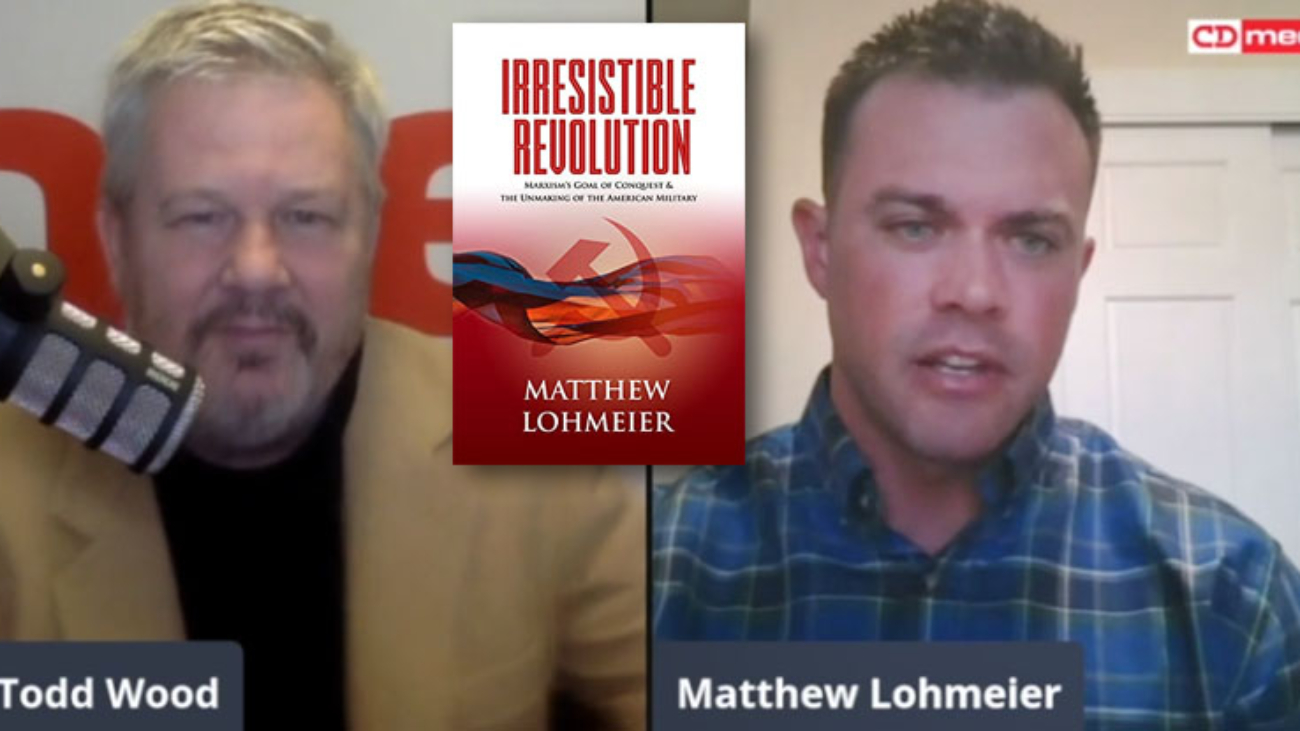
Information Operation podcast host L Todd Wood talks with Lt Col Matthew Lohmeier, USAF on his book Irresistible Revolution, and cultural Marxism in the U.S. military.
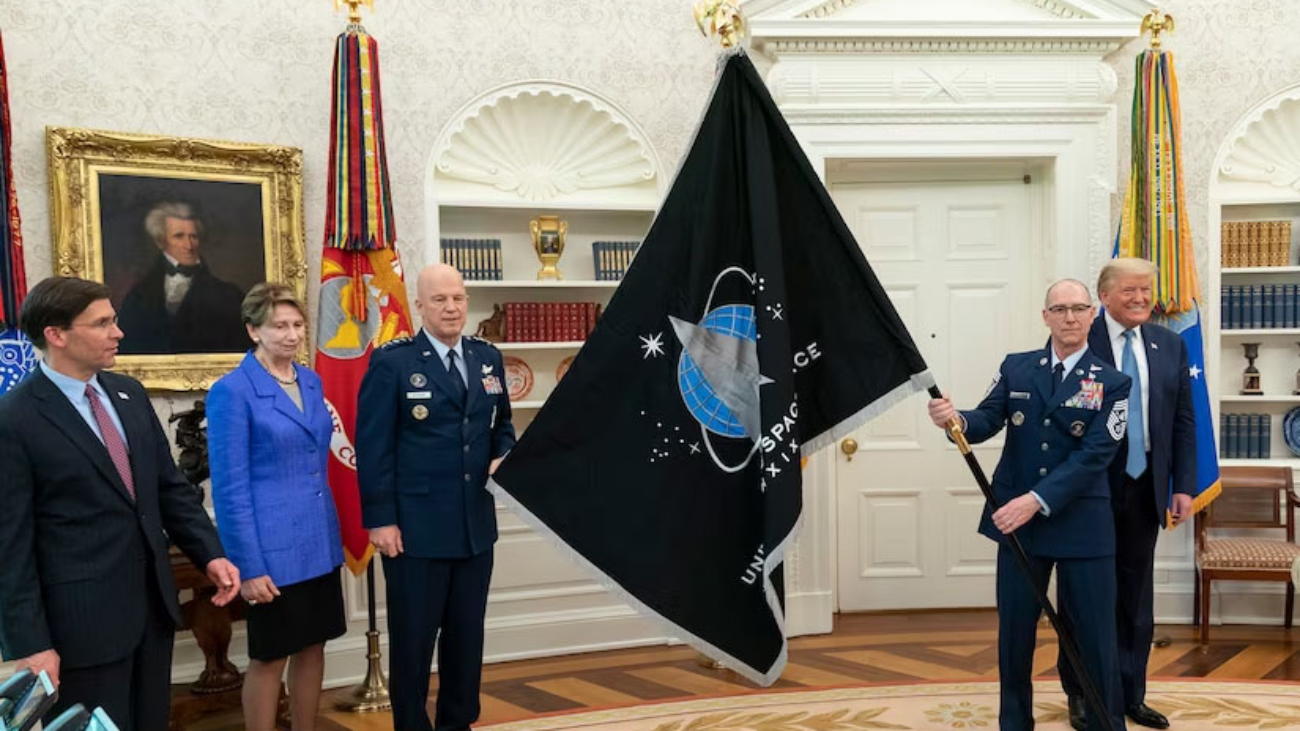
During a video teleconference with members of the military on his last Thanksgiving as commander in chief, President Trump touted his efforts to establish the Space Force, calling the newest branch of the armed services “a very important thing to me.”
Trump spoke Nov. 26 from the White House Diplomatic Reception Room with officers representing units from the Army, Navy, Air Force, Marine Corps, Space Force and Coast Guard.
The Space Force officer on the call was Lt. Col. Matthew Lohmeier, commander of the 11th Space Warning Squadron at Buckley Air Force Base, Colorado.
“You keep watch around the world to detect missile launches, space launches, and nuclear detonations while providing critical intelligence. All of you are pioneers in the newest branch of our armed forces,” Trump told Lohmeier, according to a transcript of the call released by the White House.
The 11th Space Warning Squadron operates the Defense Support Program and Space Based Infrared System satellites that detect launches and provide early warning.
Trump thanked all the officers for their service. He was especially eager to talk about the Space Force and his personal involvement in getting the service enacted as a separate branch of the military.
“Nobody thought that could happen,” Trump said. “It’s very special to me, that new branch, because that was something that I felt was necessary.”
Trump once again repeated his claim that it was him who came up with the concept of an independent space service. “Nobody even thought about Space Force,” he said. “And I looked at it, and I said ‘We’re going to have to do something’ because I looked at what China was doing and Russia was doing and others are thinking about doing.”
The idea of a separate military branch for space, however, had been championed by members of Congress before Trump became president. It grew out of a bipartisan push from the House Armed Services Committee going back to 2016, when then-chairman and ranking member of the HASC strategic forces subcommittee Rep. Mike Rogers (R-Ala.) and Rep. Jim Cooper (D-Tenn.) started advocating for a separate space branch.
Rogers and Cooper wrote language to establish a Space Corps under the Department of the Air Force. The provision was passed by the House in the 2018 National Defense Authorization Act but was defeated in the House-Senate conference.
The only difference between the Space Corps of 2017 and the Space Force of 2019 is “just one word,” Cooper told reporters last December just days before Congress passed the 2020 National Defense Authorization Act that established the U.S. Space Force.
Officer thanks Trump
“I want to thank you personally for your advocacy for an independent Space Force … We’re very grateful for that,” Lohmeier, the commander of the 11th Space Warning Squadron, told Trump. “We’re making great progress that I don’t think we were able to necessarily make while we belonged to the Air Force.”
Lohmeier in a recently published paper argued that it’s important for space operators to break free of the traditional thinking and develop an independent culture.
“The Air Force has maintained what we will call the traditional mind of space and is responsible for current military space culture,” Lohmeier wrote in a 34-page paper published in September by the Air Force’s university the Air Command and Staff College.
“Like the waning moon, the traditional mind of space is diminishing in vigor, power, and influence,” he wrote.

Paper by Matthew L. Lohmeier, Major, USAF
Wright Flyer Paper No. 79
28 September 2020
Air University Press
Muir S. Fairchild Research Information Center
Maxwell Air Force Base, Alabama
https://www.960cyber.afrc.af.mil/News/Article-Display/Article/2368354/the-better-mind-of-space/
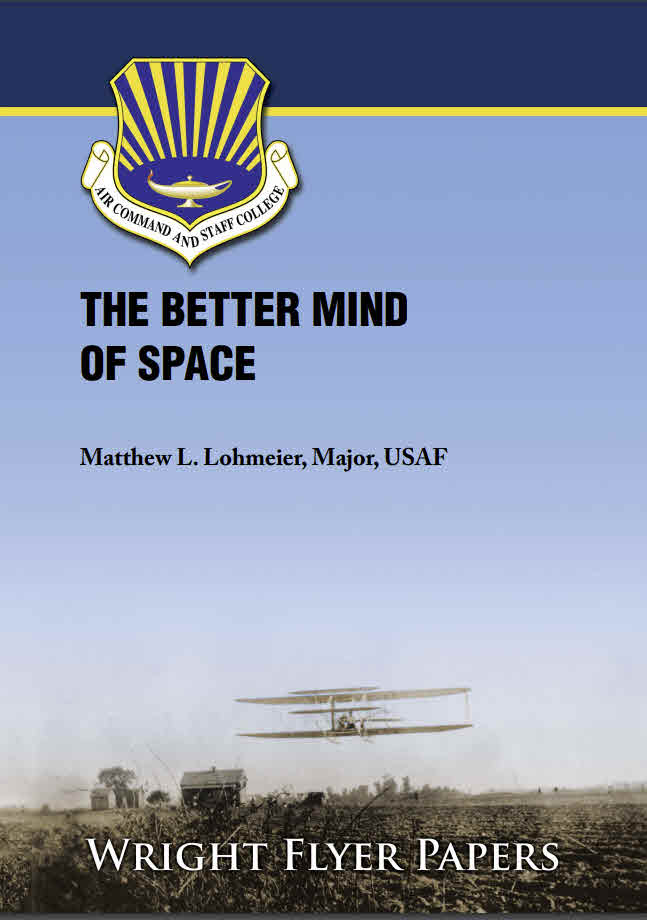 This paper explores space and space culture from two distinct perspectives. The traditional mind of space believes that air and space are indivisible and is limited from the surface of the Earth to geosynchronous Earth orbit. This mind, Maj Lohmeier argues, can limit the effectiveness of the Air Force and the now-formed US Space Force.
The emergent mind of space is one that understands the delineation between air and space and views the domain of the military as reaching as far as the moon. This mind, the author says, should be adopted by all space professionals to aid the joint fight and establish the United States’ interests in an ever-expanding military and geopolitical landscape.
[Maj Matthew L. Lohmeier / 2020 / 43 pages / ISSN 2687-7260 / AU Press Code: WF-79]
Air University Press release: The Better Mind of Space
MAXWELL AIR FORCE BASE, Ala. —
In The Better Mind of Space, Maj. Matthew L. Lohmeier, explores space and space culture from two distinct perspectives: traditional and emergent. The former has shaped the current military space culture.
This Air Command and Staff College Wright Flyer series paper was selected for excellence in student research addressing current defense challenges.
The traditional mind of space believes that air and space are indivisible and are limited to the area from the surface of the Earth to geosynchronous Earth orbit.
This mind, Lohmeier argues, can limit the effectiveness of the Air Force and the now-formed Space Force.
The emergent mind of space is one that understands the delineation between air and space and views the domain of the military as reaching as far as the moon.
This mind, the author says, should be adopted by all space professionals to aid the joint fight and establish U.S. interests in an ever-expanding military and geopolitical landscape.
It is my great pleasure to present another issue of The Wright Flyer Papers.
Through this series, Air Command and Staff College presents a sampling of exemplary research produced by our resident and distance-learning students.
This series has long showcased the kind of visionary thinking that drove the aspirations and activities of the earliest aviation pioneers.
This year’s selection of essays admirably extends that tradition. As the series title indicates, these papers aim to present cutting-edge, actionable knowledge— research that addresses some of the most complex security and defense challenges facing us today.
Recently, The Wright Flyer Papers transitioned to an exclusively electronic publication format. It is our hope that our migration from print editions to an electronic-only format will foster even greater intellectual debate among Airmen and fellow members of the profession of arms as the series reaches a growing global audience.
By publishing these papers via the Air University Press website, ACSC hopes not only to reach more readers, but also to support Air Force–wide efforts to conserve resources. In this spirit, we invite you to peruse past and current issues of The Wright Flyer Papers at https://www.airuniversity.af.edu/AUPress/Wright-Flyers/.
Thank you for supporting The Wright Flyer Papers and our efforts to disseminate outstanding ACSC student research for the benefit of our Air Force and war fighters everywhere. We trust that what follows will stimulate thinking, invite debate, and further encourage today’s air, space, and cyber war fighters in their continuing search for innovative and improved ways to defend our nation and way of life.
EVAN L. PETTUS
Brigadier General, USAF
Commandant
First, I must say thank you to my classmates in the Schriever Scholars Program. Your combined experience and insight have been incredibly valuable to me this year at school. But what will remain more important to me than your professional expertise is that you have become my friends. I look forward to serving with you and coming back to you for counsel and advice.
I, of course, would be remiss if I did not also acknowledge and thank the faculty of the Schriever Scholars program. You have challenged my thinking, opened my eyes to many important issues in national security space, and introduced me to some of the most influential men and women in the community. Thank you for introducing me to the Better Mind of Space.
Last, and most importantly, I owe a debt of gratitude to my family. I can no other answer make, but thanks, and thanks, and ever thanks.
Culture, at a fundamental level, is comprised of shared values and assumptions about reality. It has to do with what is in the mind.
Perhaps it is easier to analyze existing culture than it is to figure out how to change it. Yet that is the problem I would like to address in this paper.
Specifically, how do you improve military space culture?
Admittedly, the question is ambiguous, but it is one I have been asked many times. Implicit in the question is the assumption that military space culture needs improvement.
I do not challenge that assumption here, rather I accept it as something deserving of our time and effort.
Of course, there are a myriad of ways to address any topic, but the idea of culture seems to be among the more elusive and subjective topics of research pertaining to space and space power.
What follows is one more meager attempt to transform the elusive and subjective into something within reach.

Photos from the Department of Defense Public Affairs – Defense Visual Information Distribution Service (DVIDS):
BUCKLEY AIR FORCE BASE, CO, UNITED STATES
12.22.2016
Photo by Tech. Sgt. Nicholas Rau
460th Space Wing Public Affairs
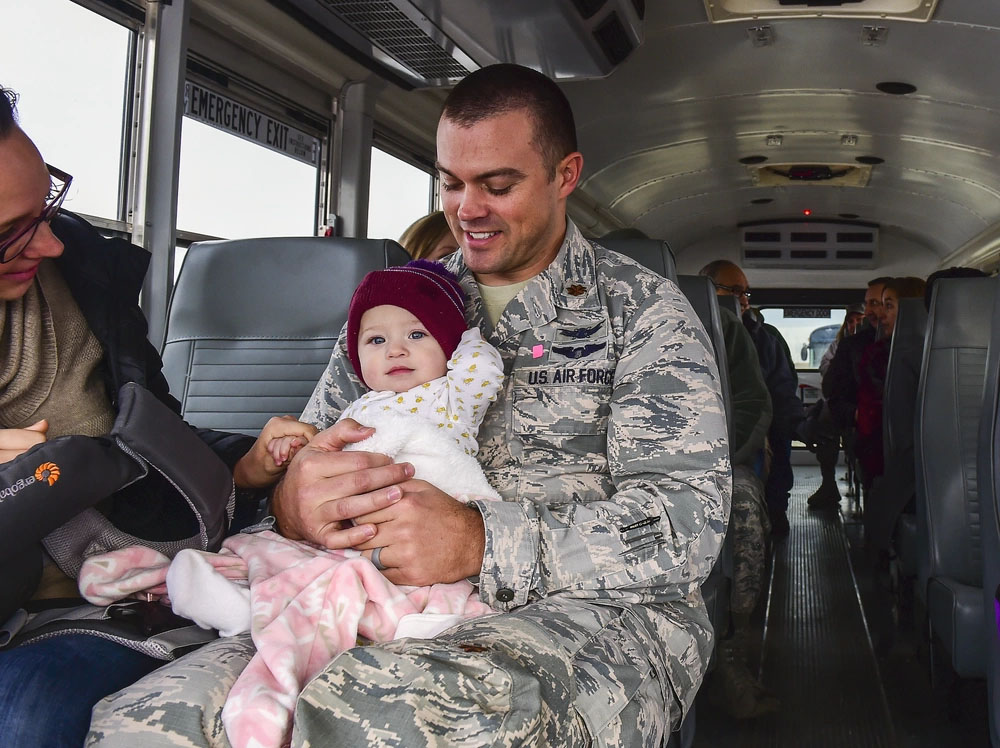
Eliza rides with her dad Maj. Matthew Lohmeier, 460th Space Wing executive officer, on her way to visit the Mission Control Station during Team Buckley Spouse and Family Day Center on Buckley AFB, Colo., Dec. 22, 2016. The event consisted of families given access to see the 460th Space Wing mission up close, with demonstrations from the operators, Defenders, and firefighters. (U.S. Air Force photo by Tech. Sgt. Nicholas Rau/Released)

BUCKLEY AIR FORCE BASE, CO, UNITED STATES
12.22.2016
Photo by Tech. Sgt. Nicholas Rau
460th Space Wing Public Affairs
Luke receives a surprise gift from Buck Lee, six-star general and Buckley Air Force Base mascot, after finishing a cupcake during Team Buckley Spouse and Family Day at the Base Chapel on Buckley AFB, Colo., Dec. 22, 2016. The event consisted of families given access to see the 460th Space Wing mission up close, with demonstrations from the operators, Defenders, and firefighters. (U.S. Air Force photo by Tech. Sgt. Nicholas Rau/Released)
Other photos from that day:
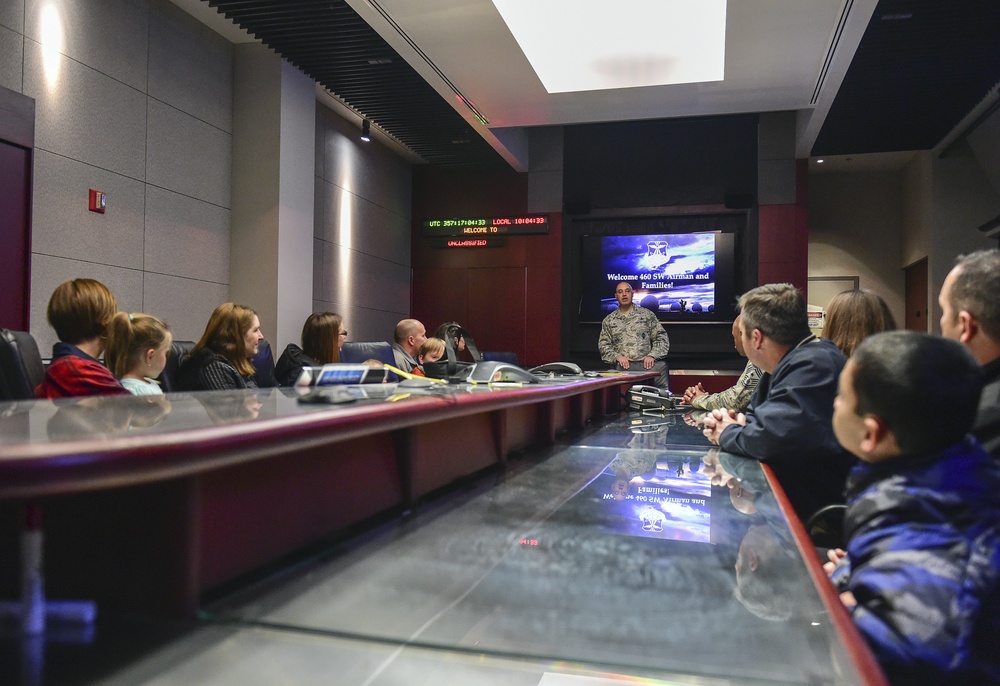
Col. David Miller Jr., 460th Space Wing commander, explains how missile warning the mission is accomplished during at Team Buckley Spouse and Family Day at the Mission Control Center on Buckley AFB, Colo., Dec. 22, 2016. The event consisted of families given access to see the 460th Space Wing mission up close, with demonstrations from the operators, Defenders, and firefighters.
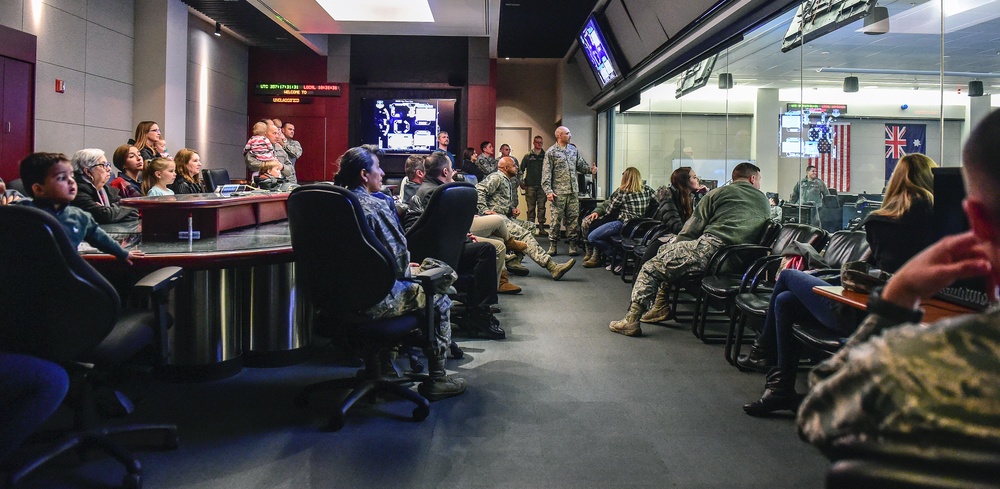
The 460th Operations Group pulls back the curtain to show attendees of Team Buckley Spouse and Family Day operators working and flying the satellites controlled inside the Mission Control Center on Buckley AFB, Colo., Dec. 22, 2016. The event consisted of families given access to see the 460th Space Wing mission up close, with demonstrations from the operators, Defenders, and firefighters